Send the exact assignment or rubric from your classroom and a custom sample written to it lands in 24 to 48 hours, the first one free. HC 306 is Herzing’s Healthcare Finance course. It centers on how a health organization takes in money and spends it, covering the revenue cycle, reimbursement methods, budgeting, and basic financial statement reading. Searches like "hc 306 unit 4 assignment example", "HC306 sample paper", and "HC 306 unit samples" land on this page.
What HC 306 is really about
HC 306 builds the financial foundation an undergraduate needs before anything at the graduate level makes sense. It starts with where money originates: government programs, commercial insurers, employers, and patients themselves, and the difference between what is charged, what is allowed, and what is finally collected. From there it works through the revenue cycle from registration and coding to claim, denial, appeal, and payment, then into the statements that summarize all of it. Budgeting arrives next, along with the arithmetic of fixed and variable cost, break even volume, and the simple ratios that tell a reader whether an organization is solvent. The register stays practical throughout.
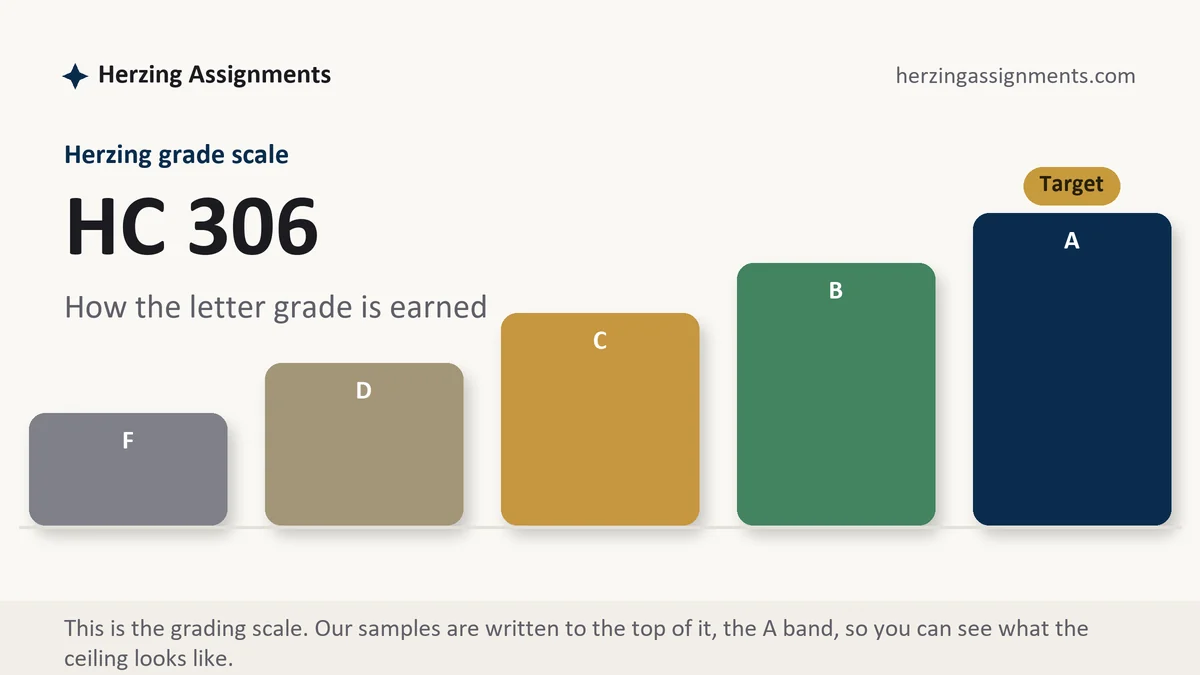
The eight units generally move from vocabulary to calculation. Early units tend to cover the payment system, the insurers inside it, and the terminology any billing conversation depends on. Middle units usually work through the revenue cycle and the financial statements, with problem sets attached to the assignment. Later units often reach budgeting, cost behavior, and a small analysis you write up. Discussions ask you to apply a term to a scenario rather than define it back. Rubrics at this level want the calculation shown step by step, and the letter grade rewards accuracy and clear explanation far more than length.
What HC 306’s assessments ask for
Assignments in this course mix problem work with short written analysis. You may be asked to follow a single claim through the revenue cycle and explain what happens at each handoff, to compute a contractual allowance and the collection that remains, or to read a balance sheet and income statement and state what the ratios suggest. Budget assignments ask you to build a small departmental budget and explain each line in it. Written pieces are typically shorter than graduate work but still expect citations for any rate or rule you quote. Discussions ask you to apply the arithmetic to a scenario and to check whether a classmate's figures actually add up the way they claim.
Where students lose points in HC 306
At this level points leak out through arithmetic that never appears. A paper explains that reimbursement varies by payer and that costs keep rising, but shows no calculation: no allowance subtracted from a charge, no share of volume assigned to Medicare, Medicaid, commercial, or self-pay, and nothing carried down to what the organization actually keeps. A written answer about money that contains no numbers cannot be graded as finance. Instructors also deduct for a formula applied with no units labeled, a ratio reported with nothing to compare it against, and loose terminology, since charge, allowed amount, payment, and adjustment mean different things and treating them as synonyms breaks the whole calculation.
The HC 306 drawers
HC 306 Unit 1 payer type comparison table example
Unit 1 often introduces how healthcare is paid for and by whom. On request, free, 24-48h.
HC 306 Unit 2 patient responsibility calculation example
Unit 2 typically covers insurance basics, coverage terms, and patient responsibility. On request, free, 24-48h.
HC 306 Unit 3 revenue cycle trace example
Unit 3 in many sections follows the revenue cycle from registration through payment. On request, free, 24-48h.
HC 306 Unit 4 charge and reimbursement comparison example
Unit 4 often turns to reimbursement methods and calculating contractual allowances. On request, free, 24-48h.
HC 306 Unit 5 financial statement interpretation example
Unit 5 typically introduces the financial statements and what each one reports. On request, free, 24-48h.
HC 306 Unit 6 cost behavior worksheet example
Unit 6 in many sections covers what drives cost and where pricing begins. On request, free, 24-48h.
HC 306 Unit 7 departmental budget worksheet example
Unit 7 often works through departmental budgeting and simple variance review. On request, free, 24-48h.
HC 306 Unit 8 finance summary report example
Unit 8 usually closes with a short financial analysis written for a manager. On request, free, 24-48h.
Your classroom shows something else?
Herzing University revises courses; unit counts and deliverables shift between terms. Send what your classroom shows and the desk matches it exactly.
Using a HC 306 sample the right way
Work through the samples as practice problems rather than as finished text. Cover the solution, try the calculation, then compare your steps against how the sample sets up its figures, labels its units, and explains what the result means in a sentence a manager would understand. That last step, the plain explanation, is where most of the marks sit at this level. When you want an example aimed at your own prompt, send the instructions and the rubric for that unit, and the first custom sample is free and returns inside 24-48h.
How these samples are written
The discipline behind every paper here: the rubric is the outline, each row gets its section, NP case work holds the clinical voice, and anything proctored stays prep-only because the sit is always yours. Send your unit's instructions with a request and the sample matches them, revisions included.
HC 306 questions, answered
What is the difference between charges, allowed amounts, and payments?
Charges are the list price, which almost nobody pays. The allowed amount is what a payer contract or fee schedule permits for that service. Payment is what actually arrives, split between payer and patient, and the gap between charge and allowed is a contractual adjustment rather than a loss. Getting these labels right decides whether the arithmetic works.
How much math does this course really involve?
Arithmetic and simple algebra, applied carefully rather than anything advanced. You will subtract allowances, compute percentages and ratios, find break even volume, and build a budget column. The difficulty is not the operation but keeping definitions straight and labeling what each number represents. Students who show every step lose far fewer points than students who show only answers.
Do undergraduate papers need citations for payment rules?
Yes, whenever you state a rule or a rate. Medicare payment policy, state Medicaid rules, and payer manuals are all published, so quote the source rather than a summary someone posted. If you use an example rate for illustration, label it as illustrative. Instructors care less about citation volume here than about whether each number can be traced.